Why Work With a Traditionally-Trained Clinical Herbalist
Why the ancient practice of personalized herbal care produces dramatically different results than searching online, and why this work was always meant to be a human-to-human journey
If you've been searching online for herbal remedies and feeling increasingly unsure about what to actually do, you're in good company. The internet is overflowing with herbal information. Some of it's good. Much of it's generic. A fair amount of it's wrong. A big chunk is downright dangerous. And nearly all of it misses the single most important element of what herbal medicine really is at its deepest and most effective level: sacred relationship.
In my clinical herbal practice here in Salt Lake City, I spend a lot of time with people who've tried to figure out herbal medicine on their own and found that it just didn't deliver what they'd hoped. They bought the recommended tinctures. They tried the popular teas. They followed the social media protocols. And something was missing. The results they were looking for didn't quite arrive, or they arrived in diluted form. Sometimes things got better and then worse, other times things just got worse.
This isn't because herbal medicine doesn't work. It works beautifully, and it's been working for human beings across cultures for thousands of years. What's missing from the online approach is the thing that makes it work in the first place. A trained practitioner who knows your specific body, your specific pattern, and your specific life, and who crafts your care accordingly.
I want to walk you through what you actually get when you work with a traditionally-trained clinical herbalist. What a session looks like. What you can expect over time. Why personalized herbal care produces results that generic approaches simply can't. And why this work was always meant to be a human-to-human journey, in a way that nothing else can replicate.
What a Traditionally-Trained Clinical Herbalist Actually Is
Let's start with what the words really mean, because the term herbalist gets used in a lot of different ways, and it helps to be clear.
A traditionally-trained clinical herbalist is someone who has studied herbal medicine deeply within an established lineage of practice. This typically includes years of coursework in materia medica (the study of specific plants and their qualities), the physiology of body systems (including anatomy, physiology, and pathology) , traditional assessment methods, formulation (how to combine herbs for individual patterns), case management, and ethics. In serious programs like the ones I’ve complete and now teach, this training also includes supervised clinical hours seeing real clients under experienced mentorship.
Alongside the clinical dimension, a traditionally-trained herbalist works within one or more lineages of herbal wisdom. These might include Western Vitalism, Ayurveda, Traditional Chinese Herbalism, European folk herbalism, or various other established traditions. Each of these lineages carries hundreds or thousands of years of accumulated knowledge about how plants work in human bodies, how to assess patterns, and how to craft care that genuinely helps.
My own training spans more than 25 years of study, including formal clinical programs in Western Vitalism, Ayurveda, and Traditional Chinese Herbalism, alongside more than a decade of private clinical practice here in Salt Lake City. I'm a Professional Member of the Association of Master Herbalists, an organization that maintains high standards of practice in the field. And I continue to study, consult with mentors and colleagues, and refine my practice continuously.
This matters because it shapes the quality of care you receive. A trained practitioner brings not just knowledge of individual plants, but the discernment to see your whole picture and the skill to translate what they see into a formula and plan that genuinely fits you. This is dramatically different from any list of recommended herbs you'll find online.
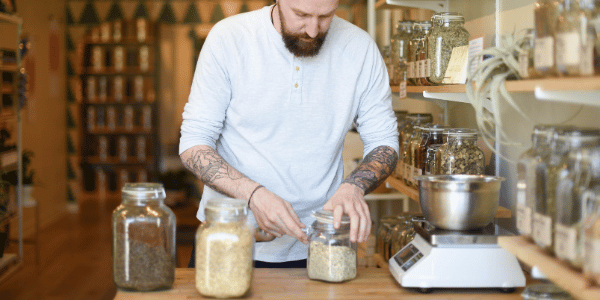
Josh working in the apothecary in Salt Lake City, Utah in 2019
What Actually Happens in a Clinical Herbal Session
If you've never worked with a clinical herbalist, it can be hard to picture what the experience actually involves. Let me walk you through what a session with me looks like, so you have a felt sense of what to expect.
You arrive and settle in
The space is calm, warm, and designed to feel like being welcomed rather than processed. You take a few minutes to arrive in your body before we begin. One of my favorite things to do in a session is make some tea for a client and check in on how they’re doing today, what they have planned after the session, and answer any questions they have for me before we get started.
We talk, slowly and thoroughly
The initial consultation lasts 90 minutes, which gives us real time to explore the full picture of what you've been carrying. We cover your presenting concerns in depth, your sleep, your energy, your mood, your digestion, your stress patterns, your menstrual cycle if relevant, your history, your medications and supplements, and the broader context of your life. This isn't quick triage. It's a thorough, unhurried exploration.
I ask questions you may not have been asked before
Clinical herbalism uses assessment methods that most conventional care doesn't touch. We look at patterns across body, mind, spirit, energy, and story. We think about your constitution. We consider the qualities of your symptoms and how they relate to each other. We trace the arc of how you arrived where you are. Many clients tell me this is the most thorough health conversation they've ever had.
We build the formula together, in the apothecary, in real time
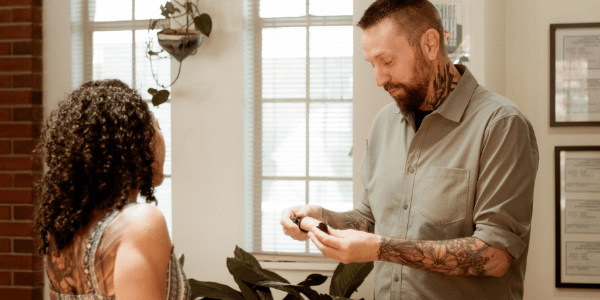
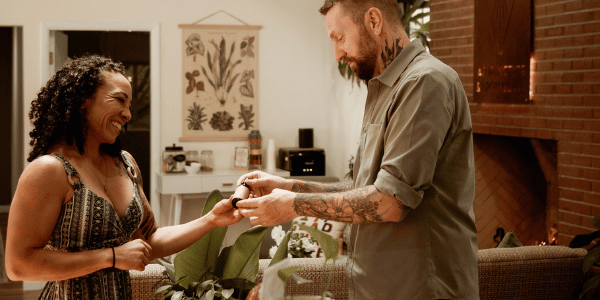
Rather than giving you a generic recommendation to pick up at the store, we walk into the apothecary at Flow Acupuncture and Apothecary and compound your custom formula together. I show you each plant going in. I tell you why it's there for you specifically. You can smell it, hold it, taste it if appropriate. The formula emerges from the conversation we just had, built specifically for the person you actually are.
We design a simple daily practice
Alongside the formula, we build a small set of daily practices that fit your real life. Maybe a tea ritual. Maybe a breath practice. Maybe a brief embodied moment of connection with the plants. Nothing elaborate. Just a few things that will support the deeper work of the herbs.
You leave with real medicine and clear next steps
Your custom formula in hand. A written summary of what we discussed. A clear picture of what to expect in the coming weeks. A scheduled follow-up if that's the right next step. And the felt sense of someone now walking alongside you in this work.
And then the real work continues over time
Follow-up sessions refine the formula as your body responds. Between sessions, I'm available for questions. Over months, we build something together that no single session could accomplish.
This is what personalized clinical herbal care actually looks like. It's relational, thorough, and genuinely tailored. And it produces results that reflect that level of care.
Why This Produces Dramatically Different Results Than Searching Online
Here's the honest truth about what you can and can't get from the internet when it comes to herbal medicine.
The internet is excellent for learning about plants in general. You can read about chamomile, about ashwagandha, about valerian, about any number of herbs that come up in nervous system support. You can learn what they're traditionally used for, what research exists, and how they're commonly prepared. This is all genuinely valuable, and I'm glad people have access to it.
What the internet can't do is match plants to you specifically. And this is where everything changes.
Consider valerian as an example. It's one of the most popular herbs for sleep. If you search for "best herbs for sleep" or "natural sleep remedies," valerian will show up repeatedly. For some people, valerian is a beautiful ally. It settles the nervous system, deepens sleep, and genuinely helps. For other people, with constitutions that run warm and already-activated, valerian is actually stimulating. It can leave them more wired, more restless, and sometimes with worse sleep than before. The same plant produces opposite effects in different bodies.
The internet can tell you about valerian. The internet can't tell you whether valerian is right for you.
This pattern repeats across every herb and every condition. Chamomile helps some people and leaves others feeling worse. Ashwagandha energizes some and sedates others. Rhodiola lifts some and overstimulates others. The right herb isn't the popular herb. The right herb is the one matched to your specific constitution, your specific pattern, and your specific body.
A trained clinical herbalist does this matching based on years of study and clinical experience. We can see signals in your presentation that tell us what your body actually needs, versus what the popular recommendation would be. We can combine herbs in ways that work together for your pattern rather than just stacking supplements. We can adjust the formula as you respond, catching when something isn't quite landing and refining accordingly.
This is why so many people who've tried herbal medicine on their own feel underwhelmed, while people working with a skilled practitioner often describe dramatic shifts. It's not that the herbs are different. It's that the matching is different. And matching is the whole game.
What You Get That You Can't Get Anywhere Else
Let ‘s explore what you receive when you work with a traditionally-trained clinical herbalist, because the list is longer and more significant than most people realize (and I think it’s pretty great, myself!)…
A custom formula built for your body
No generic recommendation. No off-the-shelf blend. A formula compounded specifically for your pattern, your constitution, and your current situation. This alone is worth the entire engagement.
Access to a working apothecary
The apothecary at Flow Acupuncture and Apothecary contains dozens of carefully sourced herbs. The quality and range available in a clinical apothecary is substantially different from what you can buy at retail. The herbs you receive are chosen for potency, sourcing, and freshness in ways most consumer products aren't.
A thorough clinical assessment
The depth of conversation in a clinical herbal session is often different from anything you've experienced in conventional care. You're seen as a whole person, your patterns are tracked carefully, and the care you receive reflects that depth of understanding.
A relationship, not a transaction
Clinical herbal care is designed to unfold over time. Your practitioner comes to know you, your body, and your patterns across months and years. This continuity allows the care to deepen in ways that one-off interventions never can.
Guidance for complexity
If you're on medications, if you have multiple conditions, if your pattern is complicated, a trained herbalist can navigate the complexity safely. We know which herbs don't combine well with certain medications. We know which patterns need special care. We can hold complexity that a search engine can't.
Permission and reassurance
Many clients describe their sessions as some of the most permission-giving experiences of their health journey. You're allowed to describe what's actually happening in your body. You're taken seriously. You're not rushed. You're reassured where reassurance is appropriate and honestly told when something needs more care than I can offer.
A broader framework for your health
Beyond the specific formula, clinical herbal care offers a way of thinking about your health that often changes everything. The whole-person framework, the recognition of patterns, the understanding of constitution, these become tools you carry forward in your life well beyond any individual formula.
Ongoing adjustment and refinement
Your body changes. Your life changes. Your formula should change with you. A clinical relationship means your care evolves as you evolve, which is impossible with any static online recommendation.
Education throughout
You don't just receive medicine. You learn as we work together. Over time, you develop your own felt understanding of the plants, your own intuition about what you need, your own vocabulary for your body. This is the deeper gift of this work.
Why Traditional Herbalism Was Always Meant to Be Human-to-Human
Now let’s look directly at something important that often gets lost in modern conversation about herbal medicine, because it matters.
Traditional herbalism has always, across every culture that practiced it, been a human-to-human journey. It was passed from elder to apprentice, from healer to patient, from grandmother to grandchild. The knowledge lived in people, and the care happened in relationship. There was no era when herbal medicine was transmitted primarily through books, let alone through screens.
This isn't an accident or a limitation of older times. It's a reflection of what herbal medicine actually is. The practice requires discernment that develops through direct experience with real bodies. It requires the ability to see subtle patterns that only reveal themselves in person. It requires the capacity to hold the unspoken dimensions of a person's experience, the things they couldn't quite put into words but that come through in how they sit, how they breathe, what they emphasize, what they skip over. All of this is relational information that only another human can fully receive.
Beyond the clinical dimension, there's a deeper truth to this. The healing itself happens in relationship. The felt experience of being seen, heard, and cared for is itself therapeutic. The confidence that comes from knowing someone experienced is walking with you lets you lean into the work in ways you couldn't on your own. The accountability of a continuing relationship keeps the practice alive when motivation flags. The accumulated trust between practitioner and client allows deeper territory to be explored safely over time.
This is why I feel so strongly that clinical herbalism, done well, can't be duplicated by any technology. Not now, not in the future, not even by very sophisticated AI systems. The work requires presence, in both directions. It requires another human receiving you and offering back something shaped specifically for who you are. It requires the slow building of trust that happens across months of real engagement.
I say this with genuine appreciation for AI tools, which are impressive and useful in many ways. For general information, for exploring questions, for various kinds of research, they're valuable. But they can't look at your face and sense what you're really carrying. They can't notice the pause when you talk about your mother. They can't adjust the formula based on how you held your shoulders during our conversation. They can't walk into the apothecary and smell the tincture bottles to pick exactly the right one for you. They can't hold the thread of your story across years of care. They can't be present with you in the embodied, felt sense that healing often requires.
The plants have always been passed hand to hand. The wisdom has always lived in people. The healing has always happened in relationship. This is not nostalgia. It's an honest recognition of what the work really is.
What You Can Expect Over Time
Let me give you an honest picture of what the arc of clinical herbal care looks like, because it's not what most people expect from quick-fix wellness marketing.
In the first two to four weeks, you'll usually notice the first shifts. These might be subtle. Sleep begins to change. The sharp edges of anxiety soften a little. Energy becomes slightly more reliable. These small changes matter. They're evidence that the formula is beginning to land and the body is responding.
Over the first few months, the deeper work unfolds. We'll meet for one or two follow-up sessions, refining the formula as your body changes. The acute concerns that brought you in often begin to meaningfully improve. New capacity emerges. The patterns underneath the surface start to shift.
Across six months to a year, the real transformation happens. Nervous system baselines reset. Chronic patterns that had seemed permanent begin to dissolve. Energy returns in ways you'd forgotten were possible. Mood steadies. Sleep genuinely restores. You start to feel like the version of yourself you'd almost stopped believing was still accessible.
Beyond a year, many clients continue in a maintenance rhythm. Occasional sessions keep the care current. Formulas evolve with seasons and life changes. The relationship becomes a long-term resource you can lean on through whatever comes.
This is slow work by modern standards. But it's deep, and it's real, and it lasts. The alternative, which is cycling through quick fixes that don't quite work, usually takes longer in the end and produces much less meaningful change.
Clinical Herbal Care in Salt Lake City
Finding a qualified clinical herbalist in your area is genuinely valuable, and if you're in Salt Lake City or along the Wasatch Front, that's exactly what I offer.
My private practice is housed at Flow Acupuncture and Apothecary at 1204 East South Temple in downtown Salt Lake City. The apothecary is a dedicated clinical space with a thoughtfully curated collection of herbs sourced for quality. The setting itself contributes to the quality of care, offering a calm and intentional space where real conversation and real formulation can happen.
I see clients from across the Wasatch Front, including Salt Lake City, Park City, Bountiful, Holladay, Sugar House, the Avenues, Millcreek, Cottonwood Heights, Orem, and beyond. For many clients, the drive is well worth it to access care that genuinely meets them. I also offer telehealth so we can meet from wherever in the world you may be- you’ll find the virtual appointment option on my scheduling page.
Alongside my clinical practice, Flow Acupuncture and Apothecary offers skilled acupuncture, which pairs beautifully with herbal medicine for many patterns. Coordinated care between my practice and the acupuncturists at Flow is welcome, and many clients work with both to support the deeper healing arc.
Who Benefits Most From This Kind of Care
Clinical herbal care isn't for everyone, and I want to be honest about that. It's a particular kind of work that suits particular kinds of people.
You'll likely benefit most if you're:
Carrying a chronic concern that hasn't responded well to simpler approaches. Chronic stress, anxiety, panic, sleep issues, mood challenges, fatigue, burnout, and nervous system dysregulation are my specialty, and these are patterns where personalized care genuinely changes outcomes.
Looking for whole-person support rather than isolated symptom management. Clinical herbalism works across the whole picture, which fits people who want to understand and address the deeper patterns in their health.
Open to the arc of real healing. The work unfolds across months, not days. If you're looking for a quick fix, this probably isn't your fit. If you're ready for genuine, sustained change, it's exactly your fit.
Values a relational approach. The work is personal and ongoing. Clients who most value this care tend to appreciate the relational dimension and the continuity of working with the same practitioner over time.
Comfortable with natural, traditional approaches. You don't need to be a long-term herbalism enthusiast, but you'll want to be genuinely open to plant medicine as a meaningful part of your care.
Able to invest in your care. Personalized clinical herbal care isn't the cheapest option in the wellness landscape. But for the quality of care offered and the results genuinely possible, it's exceptional value, and clients consistently describe the investment as worthwhile.
If this sounds like you, I'd be glad to meet you. If it doesn't, no pressure, and many other paths exist. The clarity about fit is part of what makes the work serve the right people well.
If you've been navigating chronic stress, anxiety, sleep issues, or any of the deeper patterns that bring people to this work, and you're ready for care that genuinely meets you as a whole person, I'd be honored to walk this path with you. An initial consultation is a calm, unhurried place to begin. We'll see together whether this kind of care fits what you're carrying, and if it does, we'll build something that reflects the real depth of what traditional clinical herbal medicine has always been designed to offer.
The plants are patient teachers. The wisdom has been passed hand to hand across generations. And it's still, quietly, one of the most powerful forms of care available.