When the Mind Won’t Stop: Herbal Support for Worry, Rumination, and Anxious Thinking
A grounded look at how herbal medicine can help ease the loops and spirals of an overactive mind, from a clinical nervous system herbalist in Salt Lake City
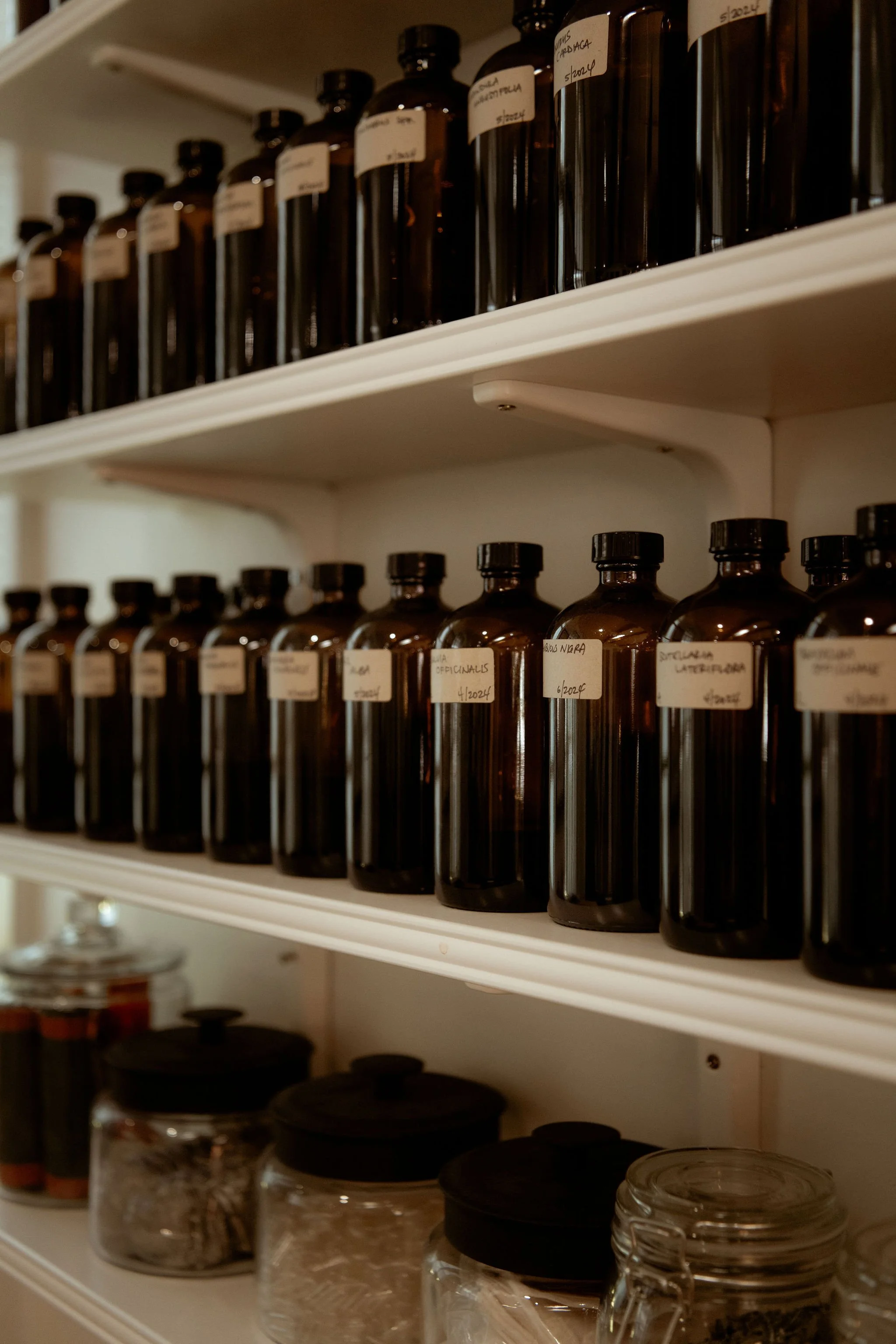
Handcrafted herbal formulas in our Salt Lake City herbal clinic and apothecary
There is a particular kind of exhaustion that comes from a mind that will not stop racing, thinking, zooming in, zooming out, and combing thru. The same worry looping through your head for the tenth time in an hour. The imagined conversation you keep having with someone about something that has not even happened yet (and probably won’t!). The catastrophic what-if that arrives at three in the morning and pulls sleep away from you entirely. The obsessive checking, the compulsive planning, the endless small rehearsals of everything that could go wrong.
If this is your daily experience, you are not alone, and I want to speak directly to you in this post. Anxious thinking is one of the most common concerns I work with in my clinical herbal practice in Salt Lake City, and while it can feel like a private and shameful struggle, it is one of the most widely shared experiences of modern life. It is also more workable than it may feel from the inside. In fact, this is one of the things that brought me to herbal medicine studies in the early 1990’s… I was so disheartened by the common approaches to these issues and knew there had to be something that was more natural, more affirming, and more attentive to the whole version of me.
There is real, meaningful help available. Some of it is herbal, some of it is therapeutic, and some of it is the daily practices that quietly change how your nervous system meets each day. The best results almost always come from weaving these together. Let me walk you through what I mean.
The Many Faces of an Overactive Mind
Anxious thinking is not one thing. It shows up in many patterns, and each of them has its own particular texture. Recognizing which patterns are most present in your own life is the beginning of caring for them well.
Worry is the low-grade, persistent hum of concern about the future. What if this goes wrong? What if I said the wrong thing? What if that pain in my body means something serious? Worry is usually specific, oriented toward real or plausible futures, and it can occupy a surprising amount of daily mental space without ever fully being acknowledged.
Rumination is the backward-looking cousin of worry. It replays past conversations, past mistakes, and past moments over and over, often with a critical or shame-laden quality. Rumination tends to feel productive while it is happening but almost never actually resolves anything. It leaves the mind exhausted and the body unchanged.
Anxious thinking is a broader pattern that includes both worry and rumination, along with the mental scanning, planning, and hypothesizing that an activated nervous system does constantly. It often runs in the background even during moments that should be restful.
Obsessive thinking is more sticky and intrusive. It is the thought that will not leave, that returns repeatedly, sometimes with distressing or unwanted content. It often carries a felt sense of urgency, as if the thought must be resolved right now.
Compulsive thinking is the mental version of a behavioral compulsion. Repeated checking, mental rituals, list-making, silent reviewing, planning, and rehearsing. These are the mind's way of trying to create the sense of certainty and control that a dysregulated nervous system craves.
Catastrophizing is the specific pattern of the mind reaching for worst-case scenarios. Small physical sensations become imagined illnesses. Small mistakes become imagined disasters. Small worries become imagined catastrophes. The mind is doing what it thinks is protective work, but the effect is exhausting and often frightening.
Any of these patterns can occur on their own, and many people experience several of them woven together. The good news is that they all share a common physiological root, which is exactly where herbal medicine, along with the right support, is well suited to help.
What All These Patterns Share Underneath
At the physiological level, all of these expressions of anxious thinking arise from a nervous system that has been in a state of alertness for too long. The mind that will not stop is doing exactly what a threat-scanning brain is designed to do. It is looking for danger, running scenarios, checking for problems, preparing for worst cases. Under normal circumstances, this scanning happens briefly and then subsides. Under chronic stress, it becomes the mind's default mode.
This is important, because it reframes the whole experience. Your looping mind is not a character flaw. It is not a sign that something is wrong with you. It is a nervous system doing its evolutionary job under conditions that never let up. The path forward is not to force the mind to be quiet through willpower. The path forward is to help the underlying nervous system come out of its state of chronic alertness. When that happens, the mind's need to loop begins to fade on its own.
This is where herbal medicine, mental health therapy, and daily nervous system practices come together into something genuinely transformative.
Therapy is Awesome
Before I go further into how herbal medicine can help, I want to say this clearly. If you are living with persistent worry, rumination, obsessive or compulsive thinking, or regular catastrophizing, please consider working with a qualified mental health therapist alongside any herbal support you explore.
Therapy is one of the most powerful forms of care available for these patterns. Modalities like Cognitive Behavioral Therapy, Acceptance and Commitment Therapy, Exposure and Response Prevention, and EMDR have decades of research behind them and have helped countless people transform their relationship with their own minds. A good therapist offers a container, a set of tools, and a skilled human relationship that herbal medicine simply cannot replace.
My work as a clinical herbalist is designed to be a support to therapy, not a substitute for it. When both are working together, the results are almost always deeper and more durable than either alone. I refer to therapists often, and I encourage every client to consider therapy as part of the fuller picture of their care.
If you do not currently have a therapist and you are living with any of the patterns described in this post, finding one is one of the most important steps you can take. Salt Lake City has a strong and growing community of skilled mental health practitioners, and I am always glad to help point you toward resources.
How Herbal Medicine Actually Helps With Anxious Thinking
Within the wider picture of therapy and daily practice, herbal medicine has a specific and valuable role to play. Let me name what it actually does, so you can understand where it fits.
It calms the body that the anxious mind lives in
The looping mind is not just a mental phenomenon. It is accompanied by an activated nervous system, held tension in the chest and jaw, shallow breath, and often digestive disruption and sleep loss. Herbal medicine works directly on that whole physiological picture, easing the body so that the mind's need to loop begins to soften.
It rebuilds the reserves that chronic worry has depleted
People who have been carrying anxious thinking for years are almost always running on empty. The nervous system is worn down. The adrenals are depleted. The nutritional reserves that support balanced neurochemistry have been drawn down. Adaptogenic and nourishing plants gently rebuild this foundation over time, and as the foundation strengthens, the mind's grip loosens.
It supports the deeper rest that the anxious mind desperately needs
Sleep is often disrupted by anxious thinking, and disrupted sleep in turn feeds more anxious thinking the next day. The right herbal support can gently interrupt this cycle by supporting genuine sleep, which is one of the most important resources the nervous system uses to regulate itself.
It helps the person feel their body again
People who spend years in their heads often lose contact with the felt sense of being in a body. Herbal medicine, especially when combined with the kind of ritual and sensory experience that a tea practice provides, gently reconnects the person to their own body, which is one of the deepest antidotes to purely mental suffering.
None of this changes the content of your thoughts directly. Herbs do not stop worry the way a distraction might, and they do not intervene in the specific mental patterns that therapy addresses so beautifully. What they do is change the state your body is in, and from that changed state, the mind naturally begins to move differently.

Why Personalized Herbal Care Matters Especially Here
The right herbs for one person's anxious mind can be entirely wrong for another person's, and this is especially true with the patterns we are discussing.
For example, one person's rumination might arise from a nervous system that is hot, dry, and over-activated, and they respond beautifully to cooling, moistening plants. Another person's rumination might arise from a nervous system that is cold, damp, and stagnant, and they need warming, moving plants that the first person would find aggravating. A widely popular calming herb might work for one and worsen the other. The one-size-fits-all approach that most herbal marketing relies on simply does not work well for something as nuanced as anxious thinking.
This is what personalized clinical herbal care is built to address. In a session together, we look carefully at the pattern of your specific anxious thinking, your constitution, your history, your stress landscape, and the shape your particular mind takes when it loops. From that picture, a custom formula is built for you, and it evolves as you evolve.
As part of your herbal remedies, I will also give you simple and effective practices you can do anytime you need them, along with the support of the herbs, to help quiet the mind, ease anxious feelings, settle the nervous system, and call forth your calm self. These practices dovetail effortlessly with drinking herbal teas, taking tinctures, applying herbal oils, or simply being present with the presence of the plants.
If any of what you have read so far resonates, an initial consultation is a great place to begin. We will explore your specific patterns together and build a personalized plan that meets you exactly where you are. Whenever you feel ready, you are welcome to reach out.
Herbs Work Best When They Are Part of a Daily Practice
Here is something I say often to my clients, because it changes results dramatically. Herbal medicine works best when it is woven into a daily practice, not taken as a standalone remedy. The herbs are one part of a fuller ecosystem of care, and when the ecosystem is present, the herbs do their deepest work.
The core of this daily practice is nervous system regulation. This includes simple, learnable techniques like heart-focused breathing, extended exhale practice, gentle humming, and the kind of felt awareness that returns your attention to the body when the mind starts to loop. These practices are quietly powerful, and they teach the nervous system a new pattern over time.
Alongside these are what I would call mindfulness practices in the broadest sense. Not necessarily formal meditation, though that can be part of it. More often, small daily rituals that anchor attention in the present moment. A slow morning tea. A brief walk without a phone. A minute of quiet with a plant before beginning work. These practices seem small, but they are exactly the kind of repeated experience the nervous system needs to reorganize itself.
When my clients come to see me, we do more than build a herbal formula together. We build a personalized daily practice that fits their real life. In a session, I teach specific techniques, help you find the ones that feel accessible, and design them around what you can actually sustain. This is where the real transformation happens. The herbs create the physical conditions for change. The daily practice provides the container. The therapy work you may be doing alongside adds the deeper reshaping. Together, all three do something none of them can do alone.
If You’re In Crisis Now…
If you are experiencing a mental health crisis, thoughts of self-harm, or feelings that your safety or the safety of others is at risk, please call or text 988, the Suicide and Crisis Lifeline, or go to your nearest emergency room. 988 is free, confidential, and available 24 hours a day, and it connects you with trained counselors who can offer immediate support.
Nothing in this post, and nothing in any herbal practice, is a substitute for that kind of immediate care. If you are in crisis right now, that is where to begin.
What Recovery From Anxious Thinking Actually Looks Like
I want to offer you an honest and hopeful picture of what change actually looks like when this work is done well, because so many people living with anxious thinking have quietly stopped believing that real change is possible.
In the first few weeks of a genuine practice combining herbal care, therapy where appropriate, and daily nervous system regulation, the shifts are often subtle. The looping does not stop. But there are moments, brief at first, when the mind is quieter than usual. A morning where a worry did not immediately grab you. An evening when a rumination surfaced but you noticed it and it passed instead of catching. These small moments are the first evidence that the underlying nervous system is beginning to shift.
Over the following months, these moments grow longer and more frequent. The loops still happen, but they take less time. The catastrophizing still visits, but it feels less compelling. The rumination still surfaces, but it does not have the grip it once did. The tools you have been building begin to work in real time. You catch yourself in a spiral and know how to come out of it. Sleep improves. Energy returns. Your relationship with your own mind begins to shift from adversarial to something closer to compassionate.
By six months of consistent work, many clients describe a fundamentally different experience of their own mind. Not the absence of anxious thoughts, but a completely changed relationship with them. Worry is no longer the center of gravity. Rumination has become an occasional visitor rather than a full-time resident. The catastrophizing is thinner, less believable, less powerful. The person you have known yourself to be underneath all the noise begins to become audible again.
This is what the work is capable of, and it is available. It takes time, and it takes the right combination of support, but it is real, and it is worth every consistent step toward it.
The results this work can produce are genuine. A calmer mind. Deeper sleep. Space between you and the loops. A body that feels safer in itself. A version of you that has more capacity for the life you actually want to live. If you are ready to move toward those results, and you are open to weaving together personalized herbal medicine, thoughtful daily practice, and, where appropriate, the support of a skilled therapist, I would be honored to walk part of that path with you.
Your mind can become a quieter place. Your body can become a safer home. And the plants, the practices, and the people who love this work are all ready to help you get there.